Workshop · WS-021
Washable door-bottom draft roll
Place a removable textile roll along one supervised interior door gap.
Editorial construction draft. Original digital diagrams; no physical build or load certification. Read dimensions, fit and use limits before making changes. US customary dimensions control; metric values are references.
Before marking and cutting
- US inches; feet where appropriate. Metric values are rounded references. Written inch values control.
- 3/4 in means measured 0.750 in actual thickness wherever used. Recalculate mating lengths for other sheet thicknesses; do not substitute nominal stock blindly.
Use limits
- No insulation, energy saving or fire/smoke-seal rating.
- Do not obstruct combustion air or required ventilation.
Materials and cuts
| Part | Qty | Size to cut | Material |
|---|---|---|---|
| A Outer shell | 1 | 38 × 9 in 965.2 × 228.6 mm | Prewashed firm washable cotton; measure after drying. Cut blank before seams or fitting. |
| B Inner filling sleeve | 1 | 37 × 8 in 939.8 × 203.2 mm | Prewashed firm washable cotton; measure after drying. Cut blank before seams or fitting. |
| C Soft ties | 2 | 1 × 12 in 25.4 × 304.8 mm | Cotton twill tape. Cut blank before seams or fitting. |
Hardware and consumables
- 1 × Polyester fiberfill. Loose fill only; quantity set by a soft hand fit.
- 1 × Sewing thread. Two enclosed seams.
Tools
- Rule with fractional inches
- Pencil or appropriate material marker
- Scissors or cutter suited to the actual material
- Straightedge
- Sacrificial cutting backing
- Sewing needle or suitable sewing machine
- Scissors
- Pins; remove and count after sewing
Assembly
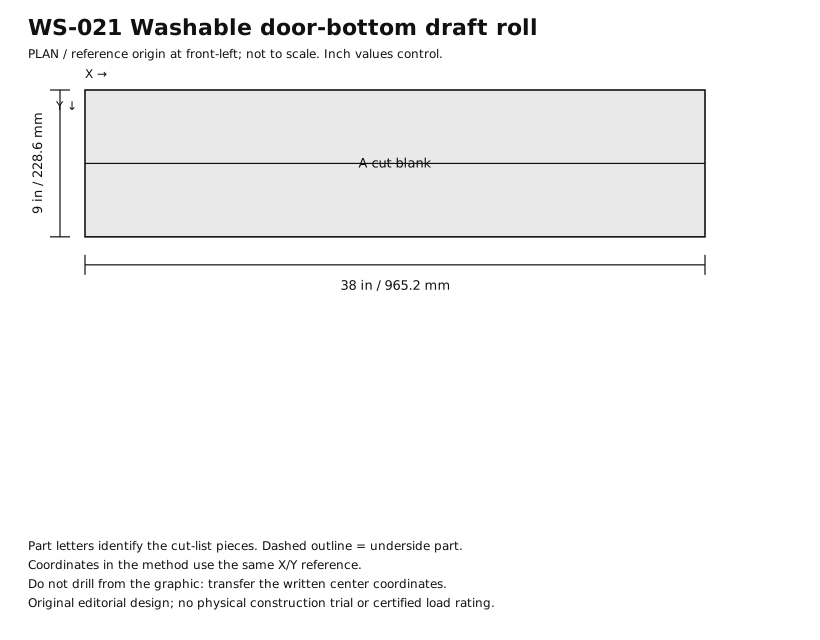
- Measure the actual door width. The example finished roll is approximately 36 in / 3 ft long and suits a 36 in-wide interior door; alter length for the measured door.
- Cut A 38 × 9 in and B 37 × 8 in after prewashing. Use clean dry polyester fiberfill, not grain or sand that can attract pests or leak grit.
- Fold B lengthwise with right sides together. Sew a 1/2 in long-edge seam and one 1/2 in end seam.
- Turn B right side out. Fill loosely so it bends without a hard pressure point; keep 2 in of the open end free of fill.
- Turn B’s open end inward 1/2 in and stitch closed twice; inspect for escaping fibers. The inner sleeve finishes about 36 in long.
- On each short end of A, turn under 1/2 in twice and stitch, reducing A’s available length from 38 to 36 in.
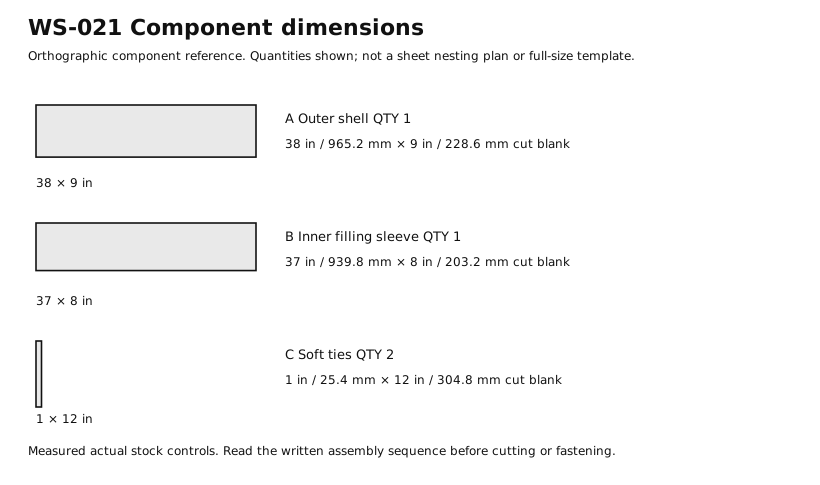
- Fold A lengthwise right sides together; sew its long edge with a 1/2 in allowance. Turn the open-ended outer shell right side out.
- Slide B inside A. Place one 12 in twill tie around each open shell end and knot short tails; remove the ties to wash the outer shell.
- Place the roll against the closed door on the room side. Check it cannot enter the hinge, trip someone or prevent the door opening freely.
- Remove the roll before using the doorway. Label it for attended interior use and keep it away from heaters and open flame.
Checks
- Inner sleeve about 36 in long with no leaking filling.
- Door opens fully after the roll is lifted away.
- Roll does not restrict a required fire/smoke door, vent or exit.
Cleaning and maintenance
- Remove fill sleeve before washing shell.
- Dry completely and inspect seams each season.
Primary context
These sources inform the context and do not endorse the original construction design.