Workshop · WS-027
Washable cool-water bottle sleeve
Add a removable padded grip sleeve around one capped room-temperature water bottle.
Editorial construction draft. Original digital diagrams; no physical build or load certification. Read dimensions, fit and use limits before making changes. US customary dimensions control; metric values are references.
Before marking and cutting
- US inches; feet where appropriate. Metric values are rounded references. Written inch values control.
- 3/4 in means measured 0.750 in actual thickness wherever used. Recalculate mating lengths for other sheet thicknesses; do not substitute nominal stock blindly.
Use limits
- Grip cover only; not a hot-liquid protector, bottle harness or validated insulation product.
Materials and cuts
| Part | Qty | Size to cut | Material |
|---|---|---|---|
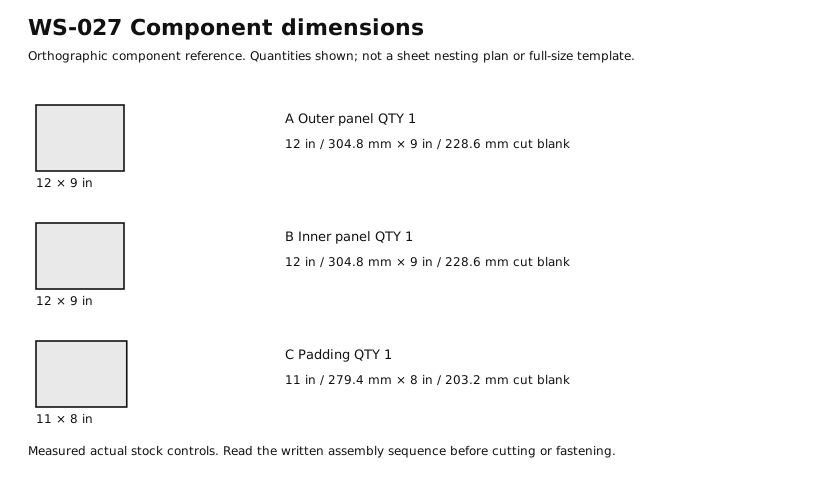
| A Outer panel | 1 | 12 × 9 in 304.8 × 228.6 mm | Prewashed firm washable cotton; measure after drying. Cut blank before seams or fitting. |
| B Inner panel | 1 | 12 × 9 in 304.8 × 228.6 mm | Prewashed firm washable cotton; measure after drying. Cut blank before seams or fitting. |
| C Padding | 1 | 11 × 8 in 279.4 × 203.2 mm | 1/8 in washable polyester batting, no insulation rating. Cut blank before seams or fitting. |
Hardware and consumables
- 1 × Paired sew-on hook-and-loop tape. Two 1 × 6 in mating strips.
- 1 × Thread. Seams and quilting.
Tools
- Rule with fractional inches
- Pencil or appropriate material marker
- Scissors or cutter suited to the actual material
- Straightedge
- Sacrificial cutting backing
- Sewing needle or suitable sewing machine
- Scissors
- Pins; remove and count after sewing
Assembly
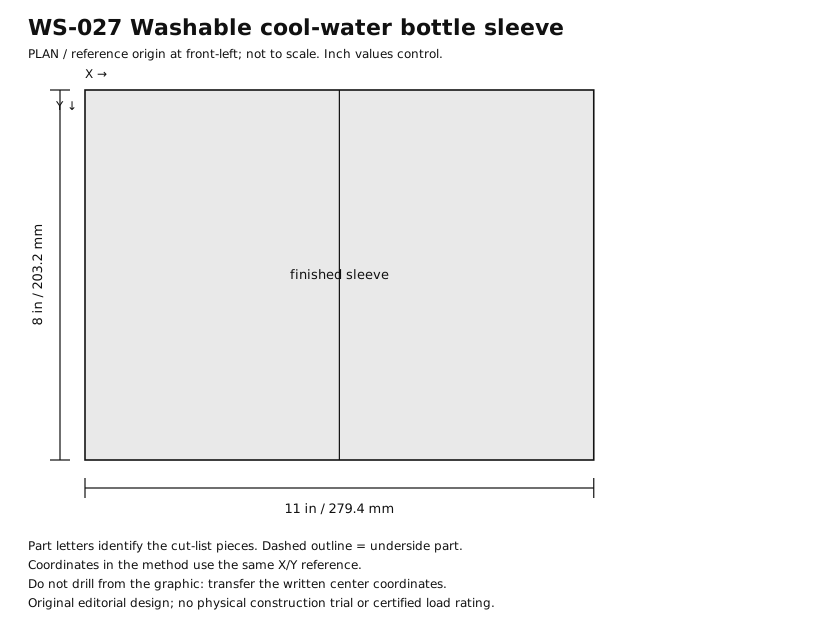
- Measure the bottle circumference. This sleeve assumes 10 in circumference and leaves closure overlap; it must not cover the cap or required labeling.
- Cut A and B each 12 × 9 in and C 11 × 8 in. Do not use this on hot-liquid bottles.
- Put A and B right sides together. Sew a 1/2 in seam along both short sides and one long side; leave the other long side open.
- Clip bulky corner allowance without cutting stitches, then turn the shell right side out. Its intended face is 11 × 8 in.
- Slide C into the shell and smooth it flat. Turn the opening allowance inward 1/2 in and stitch closed.
- Sew a vertical quilting line at X = 5 1/2 in through all layers to prevent batting bunching.
- Sew a 1 × 6 in loop tape vertically near one short end and matching hook tape on the opposite back face, leaving 1/2 in edge margins.
- Wrap around the capped bottle and mate the tape with about 1 in overlap. Check the base of the bottle remains fully exposed and level.
- Grip the bottle by its body above the sleeve before lifting for the first trial. If the sleeve slips, do not use it as a carrying handle.
- Remove for washing; dry separately and inspect the bottle’s own cap and body.
Checks
- Finished sleeve near 11 × 8 in with 1 in overlap on stated bottle.
- Bottle bottom and cap remain unobstructed.
- No carrying handle or temperature-holding claim is made.
Cleaning and maintenance
- Remove daily if damp.
- Wash and dry all layers completely; inspect closure stitching.
Primary context
These sources inform the context and do not endorse the original construction design.