Garden · GA-024
Pair of broad leaf pickup paddles
Gather loose leaves between two broad hand-held paddles without compressing them against bare hands.
Editorial construction draft. Original digital diagrams; no physical build or load certification. Read dimensions, fit and use limits before making changes. US customary dimensions control; metric values are references.
Before marking and cutting
- Measure the stated stock sections before cutting. Use the cut-list geometry, not scale measurements from the drawing.
- US inch dimensions control; millimeter values are rounded conversions. Ordinary cut target ±1/16 in (1.6 mm); fit commercial accessories before boring attachment holes.
Use limits
- Original bounded garden component, not an occupied structure.
- No human standing, sitting, climbing, lifting or fall protection use. No stated safe working load.
- Geometry and fastener quantities are editorially checked; no prototype build, wind test or crop trial is claimed.
Materials and cuts
| Part | Qty | Size to cut | Material |
|---|---|---|---|
| P01 Paddle faces | 2 | 16 × 12 × 1/2 in 406.4 × 304.8 × 12.7 mm | measured 1/2 in plywood exterior-bond plywood for protected non-food-contact fixtures; substitute thickness only by recalculating joints |
| P02 Hand blocks | 2 | 8 × 1 1/2 × 3/4 in 203.2 × 38.1 × 19.05 mm | 1 × 2 in board sound untreated cedar or other durable untreated wood; no unknown salvage |
Hardware and consumables
- 8 #8 × 1 in screws, 4 per hand block
- 2 soft 1 in webbing straps, each 12 in long
- 8 #8 × 3/4 in washer-head screws, 4 per strap
- The pair is one project, not two counted units
Tools
- Tape measure and steel rule
- Pencil, square and clamps
- Saw suited to the stated stock; eye and hearing protection
- Drill/driver, countersink and bits matched to fasteners
- Sandpaper and edge file; gloves when handling cut mesh
Assembly
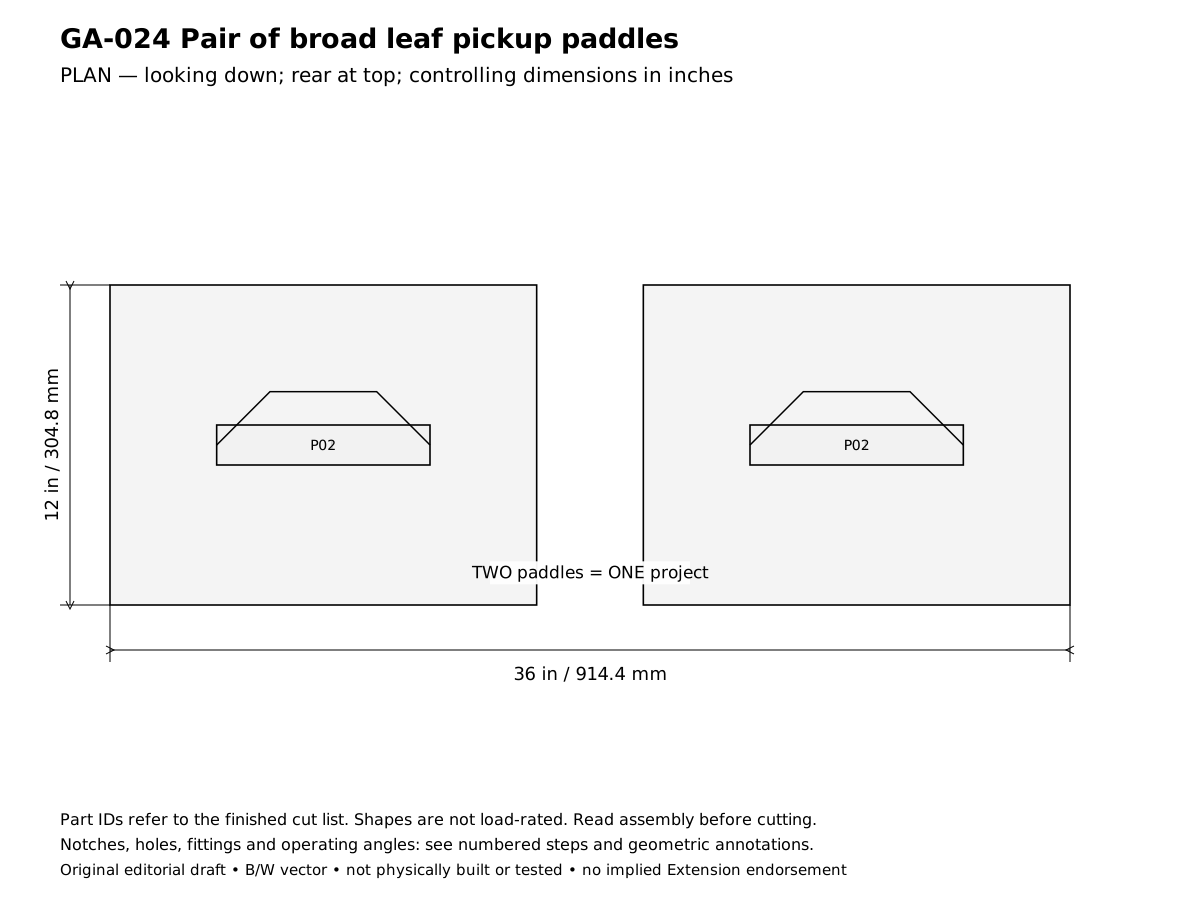
- Plan the pair of broad leaf pickup paddles for this result: Gather loose leaves between two broad hand-held paddles without compressing them against bare hands. Confirm the design reference before cutting: Both faces smooth, straps secure and no screw points exposed. In the drawings x runs left to right, y runs front to rear and z runs upward.
- Verify the required stock before laying out these parts: 1 × 2 in board: actual 0.75 × 1.5 in (19.05 × 38.1 mm); measured 1/2 in plywood: measured thickness 0.5 in. Reject split or twisted wood and unknown salvage; thinner stock requires recalculating the joints, not simply using the listed lengths.
- Cut and label the finished parts: 2 Paddle faces 16 × 12 × 0.5 in (406.4 × 304.8 × 12.7 mm), mark P01; 2 Hand blocks 8 × 1.5 × 0.75 in (203.2 × 38.1 × 19.05 mm), mark P02. Keep saw kerf outside each finished line. Rip only where the finished width is narrower than the actual stock; use a suitable guide and target ±1/16 in (1.6 mm) for ordinary cuts. Dowel triples mean length × diameter × diameter, not square dowel stock.
- Mark a 1 in radius at every paddle corner. Cut outside each arc and sand to a smooth continuous curve.
- Mark each hand block along the paddle centerline, x = 4–12 in on the first face and x = 24–32 in on the second.
- Drill four underside pilots per block at 1, 3, 5 and 7 in along its length. Keep the screw row centered in the block width.
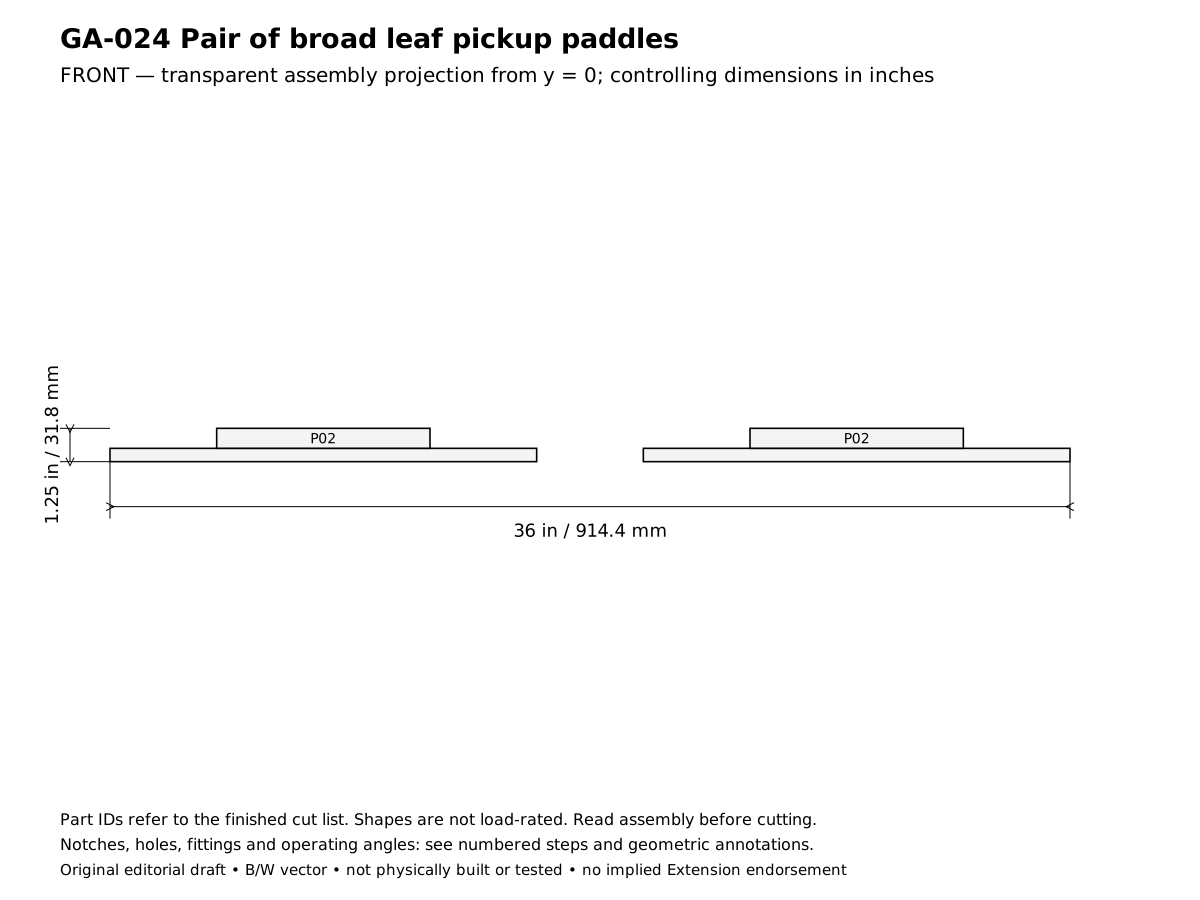
- Fasten blocks with 1 in screws from the paddle underside. Their points must remain at least 1/4 in below the block upper face.
- Place a webbing strap over each block to make a hand loop, leaving comfortable glove clearance. Keep the two ends on the block top, not on thin plywood.
- Attach each strap end with two 3/4 in washer-head screws. Fold a 1 in doubled tail under each end before fastening so the cut webbing is captured.
- Test the loops wearing the intended gloves. Hands must withdraw quickly; loosen an over-tight loop rather than using it as a restraint.
- Scoop a small pile of dry leaves between the paddles and transfer to the bay. Do not clamp sticks, sharp debris, animal waste or hot material between the faces.
- Complete the acceptance checks below before putting the assembly into service. Record any changed stock thickness, fastener or equipment fit on the project sheet. The published geometry has not been physically built or load-tested.
Checks
- Both faces smooth, straps secure and no screw points exposed.
- Hands release easily from loops; pair closes without trapped fingers at edges.
Operation
- Leaf handling only, not sharps protection or machinery.
Cleaning and maintenance
- Brush clean, dry straps and inspect attachments each session.
Primary context
These sources inform the context and do not endorse the original construction design.