Poultry · PO-016
Ventilated feed-store sack pallet
Keep a sealed feed container or briefly staged intact sack above a dry storeroom floor; the pallet itself is not a rodent-proof feed container.
Editorial construction draft. Original digital diagrams; no physical build or load certification. Read dimensions, fit and use limits before making changes. US customary dimensions control; metric values are references.
Before marking and cutting
- Read every step and identify the installed orientation. Make the component off-site with birds excluded.
- Measure the actual receiving space, chosen commercial accessories and access route. Stop if the example does not fit; changing only one member can invalidate the assembly.
- Reject split, warped, moldy or chemically contaminated stock. Keep exposed mesh cut ends and all sharp fasteners inaccessible to birds.
- The drawing dimensions control; illustrations are not full-size templates. Allow a saw kerf between parts when laying out stock.
Use limits
- No person may stand or sit on this component. No tested load rating is claimed.
- A site-specific safe location and supervision are required; remove it if birds become trapped, peck damaged material, or cannot use their normal feed, water, shelter and escape routes.
Materials and cuts
| Part | Qty | Size to cut | Material |
|---|---|---|---|
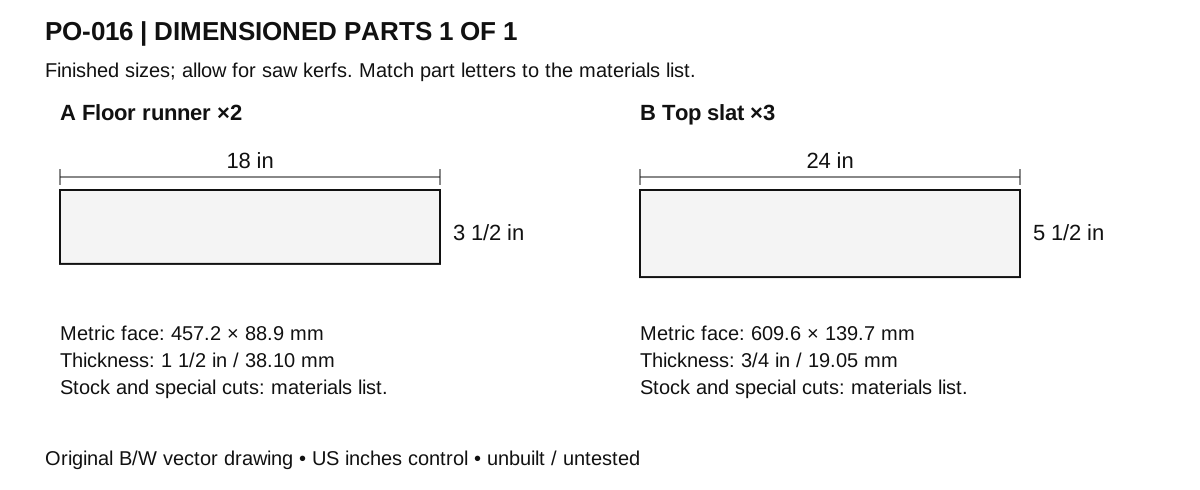
| A Floor runner | 2 | 18 × 3 1/2 × 1 1/2 in 457.2 × 88.9 × 38.1 mm | Untreated sound straight softwood. Square ends; remove splinters. |
| B Top slat | 3 | 24 × 5 1/2 × 3/4 in 609.6 × 139.7 × 19.05 mm | Untreated sound straight softwood. Square ends; remove splinters. |
Hardware and consumables
- 12 × #8 corrosion-resistant exterior wood screw 1 3/4 in (44.45 mm). Four per slat. Use compatible coatings/metals and the maker's pilot-hole guidance; do not substitute drywall screws.
Tools
- Tape measure, square and pencil
- Saw appropriate to material and work supports
- Drill/driver, countersink and pilot bits selected for the screws
- Clamps, sanding block and eye/hearing protection; dust control appropriate to the material
Assembly
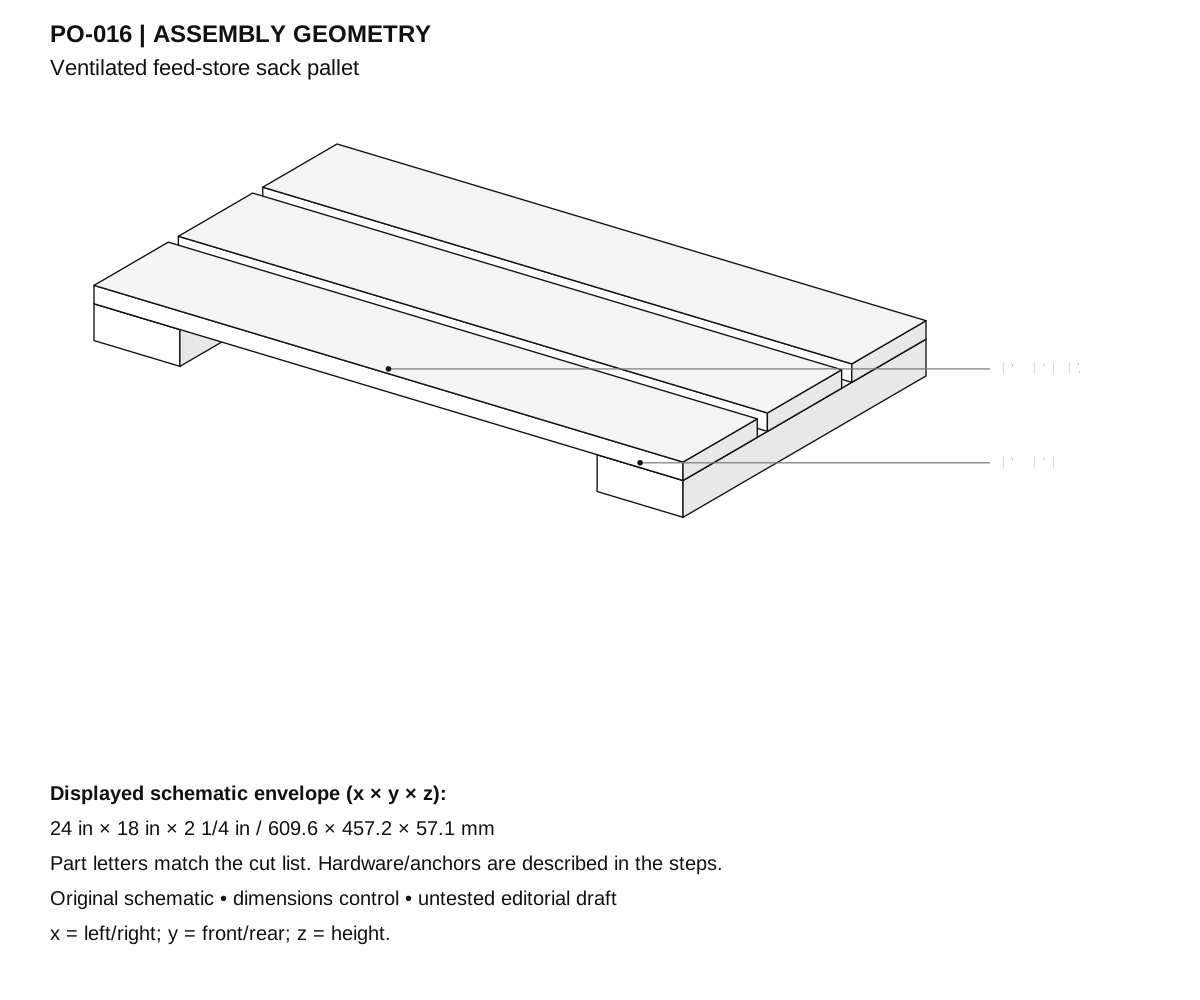
- Choose a dry feed storeroom location beyond flock access; a pallet does not protect feed from rodents, moisture or pecking.
- Cut A runners to 18 in (457.2 mm) from actual 1 1/2 × 3 1/2 in stock.
- Cut three B slats to 24 in (609.6 mm) from actual 3/4 × 5 1/2 in stock; sand upper edges so a sack cannot catch a splinter.
- Lay A with wide faces down and outside edges 24 in apart. Their front/rear ends align.
- Lay the first B at y = 0–5 1/2 in, the second at y = 6 1/4–11 3/4 in, and the third at y = 12 1/2–18 in.
- Check both gaps are exactly 3/4 in (19.1 mm). Each slat's ends must be flush with the runner outer faces.
- Mark two screw positions above each runner on each slat, separating them across the 5 1/2 in slat width and keeping 3/4 in from the slat ends.
- Pilot and drive four 1 3/4 in screws per slat; after the 3/4 in top they enter A by 1 in (25.4 mm), with no point underneath.
- Check level with the pallet empty. Do not cure rocking by stacking loose shims that can harbor pests.
- Place only an actual stable container/sack whose bottom is fully supported by the 24 × 18 in footprint; no stacked-sack load or rated capacity is claimed.
- Keep storage access clear so the pallet can be lifted and the floor checked; do not use it as a step.
- If feed spills, remove it promptly and inspect under every slat. Dry wet stock and replace moldy wood; use a suitable animal/moisture-proof commercial container for actual feed storage.
Checks
- Overall footprint is 24 × 18 in; two 3/4 in gaps separate the three 5 1/2 in slats.
- Overall height is 2 1/4 in (57.2 mm); all twelve screws remain within the 2 1/4 in assembly.
- Stable floor placement and no projecting corners, nails or unsupported sack edge.
- Feed remains in a suitable closed container; the pallet carries no pest-exclusion or tested-load claim.
Cleaning and maintenance
- Inspect before each use for splits, loose joints, protruding points and trapped debris.
- Remove accumulated litter or manure promptly. When cleaning is needed, move birds away, remove debris first, wash and use only a suitable label-directed product if disinfection is indicated; let the item dry before return.
- Recheck the fit after seasonal wood movement. Replace cracked panels, rusted fasteners or frayed liners instead of concealing damage.
- Sand accessible edges to a small smooth radius. Use a removable washable contact liner where specified. Any optional coating must be suitable for the intended animal-equipment use and fully cured according to its label before installation. Porous wood is not represented as a disinfectable food-contact surface.
Primary context
These sources inform the context and do not endorse the original construction design.