Workshop · WS-053
Removable water-container date collar
Display a user-written inspection date on an existing potable-water container without modifying its cap.
Editorial construction draft. Original digital diagrams; no physical build or load certification. Read dimensions, fit and use limits before making changes. US customary dimensions control; metric values are references.
Before marking and cutting
- US inches; feet where appropriate. Metric values are rounded references. Written inch values control.
- 3/4 in means measured 0.750 in actual thickness wherever used. Recalculate mating lengths for other sheet thicknesses; do not substitute nominal stock blindly.
Use limits
- No water treatment, testing, shelf-life or potability claim.
Materials and cuts
| Part | Qty | Size to cut | Material |
|---|---|---|---|
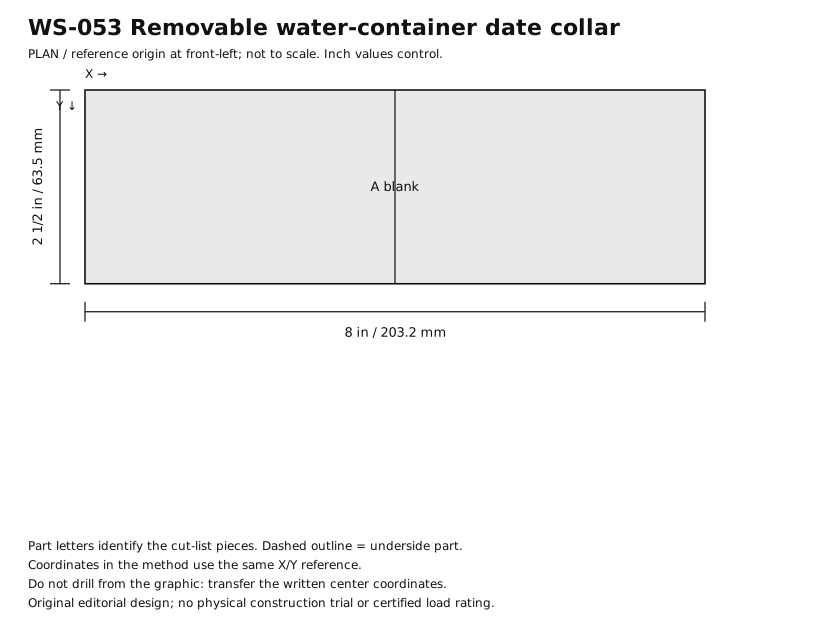
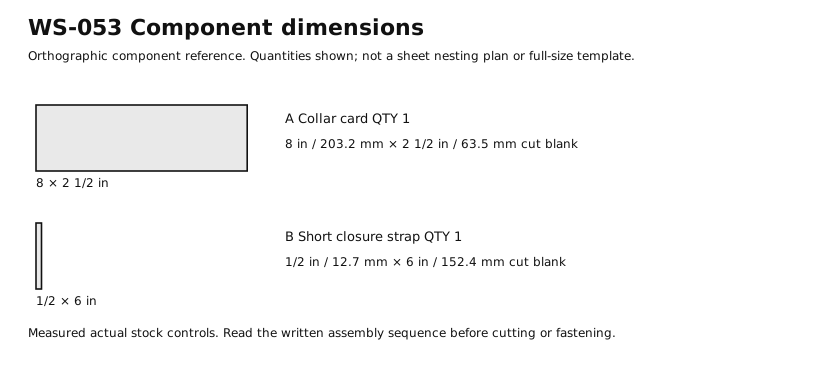
| A Collar card | 1 | 8 × 2 1/2 in 203.2 × 63.5 mm | 0.020 in clear flexible polypropylene. Cut blank before seams or fitting. |
| B Short closure strap | 1 | 1/2 × 6 in 12.7 × 152.4 mm | Reusable hook-and-loop strap. Cut blank before seams or fitting. |
Hardware and consumables
- 1 × Removable document-tape tab. For paper pocket only.
Tools
- Rule
- Marker
- Scissors
- Hole punch
- Tape
Assembly
- Use a container specifically suitable for potable water. This collar is a label and does not establish treatment, storage duration or water safety.
- Measure an available handle opening that does not interfere with cap, vent or pouring. The collar must attach to the handle, never under a sealing cap.
- Cut A 8 × 2 1/2 in and round corners to 1/4 in radius.
- Mark a fold at X = 4 in to create a 4 × 2 1/2 in two-face card. Cold-fold without scoring through the polymer.
- Write container ID, fill date and next owner-defined inspection date on a 3 × 1 1/2 in paper insert; make no printed safe-until date.
- Place the insert inside A and secure the open short edge with a small removable document-tape tab.
- At the card’s folded upper margin mark one 1/4 in hole centered 1/2 in from the edge; punch over backing and smooth its rim.
- Pass B through that hole and the container handle, leaving a short slack loop; keep the card outside the pouring path.
- Lift the actual empty container by its original handle and check that the label cannot snag or force a hand away from the handle.
- Update the insert after actual cleaning/filling and keep the container’s own original labels visible.
Checks
- No cap, vent, seal or container wall is altered.
- Paper insert readable and replaceable.
- Collar attaches only to the original handle and clears pouring.
Cleaning and maintenance
- Inspect label after handling.
- Replace torn polymer; update dates from actual actions.
Primary context
These sources inform the context and do not endorse the original construction design.